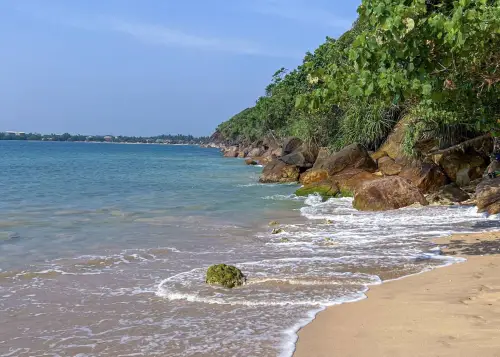
I want to tell you about Jungle Beach in Unawatuna, a place that was once described as “secret”. Today it is better understood as a small beach hidden among greenery rather than a truly unknown spot. It is a good choice if you want to exchange busy Unawatuna for a more intimate bay for a few hours, but you should arrive prepared: the route includes a climb and a forest trail, and both the path and the sea conditions can change.
Sri Lanka’s official tourism portal describes Jungle Beach as a small, secluded beach near Rumassala, about 7.5 km from Galle. The approach goes up Rumassala Hill and then down through a green trail. Different maps and traveller reports show different starting points, so do not expect a tuk-tuk to reach the sand. The final section is on foot.
What kind of beach is it?
Unawatuna is a resort village near Galle. Its main beach usually has more visitors, cafés and familiar tourist facilities. Jungle Beach is set apart among trees and rocks. The walk is part of the experience: first the road climbs, then a trail descends through greenery, vines and uneven ground. On a clear day there are attractive ocean views along the way.
When we visited, the beach felt almost empty, probably because the weather was cloudy. On another day it may be busier, especially at weekends and during the high season. “Wild” and “secluded” should therefore describe the atmosphere of a particular visit, not guarantee that no one else will be there.
Getting there from Unawatuna
For a first visit, the simplest option is to take a tuk-tuk to the start of the walking approach and agree in advance where the driver will wait. Do not assume that the vehicle can reach the beach itself. Save the starting point on a current map and check the return route before leaving: mobile reception may be less reliable in the greenery, and an unfamiliar trail is not a good place to walk after dark.
If you are travelling from Hikkaduwa, leave extra time for traffic and the road. I am not giving the old fixed “20 minutes” estimate because actual travel time depends on your starting point, transport and traffic. Jungle Beach can be combined with Galle or another southern-coast stop, but do not pack too many places into one short day. Keep time for the return climb and an unhurried visit.
The trail and physical effort
This is not a flat promenade. You may encounter a climb, a descent, roots, rocks, wet soil and uneven steps. After rain the path can be slippery. Wear shoes with good grip rather than smooth flip-flops, and walk at a pace that does not require rushing. The route may be uncomfortable for small children, people recovering from injuries or anyone who finds slopes difficult.
Do not cut through vegetation or cross fences and private land. Trails can change because of rain, maintenance and erosion. If a local sign differs from an old online route, follow the current safe passage. The climb back often feels harder than the descent, so do not wait until darkness to leave.
What to expect at the beach
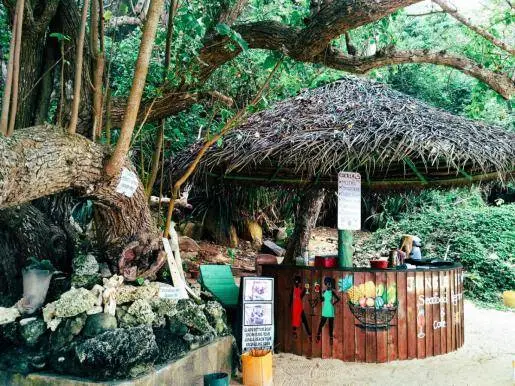
The beach is small, with rocks and trees close to the sand and a small food or drinks stall if it is open on the day. Do not plan as if toilets, showers, loungers, a lifeguard, reliable internet or a large food selection are guaranteed. Bring water, sun protection and a small rubbish bag, and take everything back with you.
The original note mentioned a rope swing and jumping into the water. I would not treat these as an equipped attraction: fixings, depth and the condition of the landing area may change, and safe depth is not visible from above. Do not jump from rocks or use a structure unless you can assess it yourself. A good photograph is not worth an injury.
Swimming and snorkelling
A bay can look calmer than open water, but that does not mean conditions are always safe. Check waves, currents, rocks, reefs and other swimmers before entering. Do not swim far alone, turn your back on shore break near rocks or enter after heavy rain when visibility is poor. If local people or beach staff advise against swimming, postpone it.
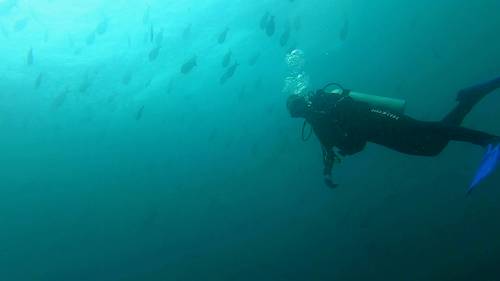
The official tourism portal lists snorkelling as one possible activity at Jungle Beach. That is an option when conditions are suitable, not a promise of clear water or abundant marine life. Use working equipment, do not touch coral and do not stand on the reef. Children need an adult close by in the water, not supervision from the shore.
When to go
Plan the visit in daylight and leave time for the return. A cloudy day may be comfortable for the climb and photographs, but rain can make the trail harder and reduce water visibility. Seasonal conditions on the south coast do not guarantee identical weather every day. Check the forecast and sea conditions before leaving, then decide based on what you actually see on site.
Weekdays may feel quieter, but this is not a promise. Weekends can bring more local visitors. If you want a calmer atmosphere, arrive earlier and do not expect a small bay to be exclusively yours.
What to bring
- water and a snack in case the stall is closed;
- grip footwear for the climb and forest trail;
- swimwear, a towel and dry clothes;
- sun protection, a hat and insect repellent;
- a phone with the route saved, without relying on reception alone;
- a rubbish bag and a waterproof pouch for documents.
Conclusion
Jungle Beach is worth visiting if you enjoy a short forest approach, greenery, rocks and a small bay. It is not a beach with guaranteed services, and it is not a place to jump into the water from any height without preparation. Choose daylight, wear suitable shoes, check the weather and sea, and leave time for the climb back. The visit is then much more likely to be pleasant than a rushed search for one dramatic photograph.
Sources: Sri Lanka Tourism — Jungle Beach; Sri Lanka Tourism Development Authority — Tourist Attractions.