Sri Lanka and Thailand often end up on the same shortlist for travelers looking for a warm Asian destination for a holiday, winter escape, or several months by the sea. Both offer tropical beaches, Buddhist culture, distinctive local food, relatively affordable living, and well-developed tourism. But the travel experience itself is very different.
Sri Lanka is a compact island where, in two weeks, it is realistic to combine ancient cities, mountains, tea plantations, safaris, and the ocean in a single route. Thailand is a much larger country, and trying to “see Thailand” in one short trip usually means too many flights and transfers. It makes more sense to choose a specific combination — for example, Bangkok + Chiang Mai + Krabi or Phuket — or spend the whole holiday on the southern islands.
If the difference had to be reduced to one sentence, Sri Lanka is stronger as a compact, eventful journey through very different regions, while Thailand is stronger as a country with a huge choice of separate travel styles: beaches, cities, islands, food, nightlife, healthcare, remote work, and long-term living.
| What matters most | Sri Lanka | Thailand |
|---|---|---|
| 10–14 day trip | Easy to build a varied route covering much of the country | Better to choose 2–3 regions rather than try to cover the whole country |
| Classic beach holiday | Very good, but sea conditions depend on season and coast | Huge choice of islands, bays, and resorts; a major advantage in variety |
| Surfing | Strong destination, especially the south and Arugam Bay | Good spots exist, but Thailand is better known for islands, diving, and beaches |
| Snorkeling and diving | Good in some places, but with a more limited choice | Very strong: the Andaman Sea, Koh Tao, and many islands |
| Nature and wildlife | Safaris, elephants, leopards, tea-covered mountains, waterfalls | Jungle, mountains, karst cliffs, marine parks, and islands; large wild animals are harder to see |
| History and culture | Ancient capitals and Buddhist heritage fit easily into one route | Very rich culture: temples, Bangkok, Ayutthaya, Sukhothai, and northern Thailand |
| Food | Distinctive and inexpensive local cuisine | One of Thailand’s biggest strengths: enormous choice of local and international food |
| Infrastructure | Sufficient for travel, but uneven | Much stronger: transport, healthcare, shopping, delivery, services, housing |
| Remote work | Possible, but the ecosystem is concentrated in a few places | Strong infrastructure and a 5-year DTV |
| Everyday expenses | Lower on average | Vary greatly by region: the north can be inexpensive, while islands and Bangkok cost more |
| Transport | Trains, buses, tuk-tuks; journeys are slow | Domestic flights, trains, buses, ferries, urban transit, ride-hailing apps |
| Long stays | One-year DNV, but conditions are fairly strict | 5-year DTV and up to 180 days per entry; more convenient for many remote workers |
The Main Difference: One Compact Country or Many Different Thailands
It is not quite accurate to compare Sri Lanka and Thailand as two similar beach destinations.
Sri Lanka covers about 65,000 km². Distances are not always quick to travel, but the country is compact enough that one trip can include very different regions. A route can begin near the ancient cities of the Cultural Triangle, continue through Kandy and the cool tea-growing highlands, pass through a national park, and finish by the ocean.
Thailand is roughly eight times larger by area and works more like a collection of very different destinations. Bangkok is a huge modern metropolis. Chiang Mai and the north offer mountains, temples, markets, and a completely different rhythm of life. Phuket is a major tourist island with extensive infrastructure. Krabi is known for limestone cliffs, boat trips, and islands. Samui, Phangan, and Tao form another separate cluster in the Gulf of Thailand.
So on a first two-week trip through Sri Lanka, it is realistic to feel that you have seen a significant part of the country. In Thailand, it is smarter to give up that idea in advance and choose a few regions. Sri Lanka is better for one coherent journey; Thailand is better for repeated trips, each of which can feel completely different.
Beaches: Thailand Offers More Choice, Sri Lanka Feels More Like the Open Ocean
If the comparison is specifically about variety in beach holidays, Thailand is one of the strongest options in Asia.
On the Andaman coast are Phuket, Krabi, Koh Lanta, Phi Phi, the islands of Trang Province, and many smaller islands. It is easy to find white sand, clear water, limestone cliffs, sheltered bays, snorkeling, and boat trips. Koh Lanta, for example, combines long beaches and developed infrastructure with a noticeably calmer atmosphere than Phuket.
The Gulf of Thailand offers a different set of destinations: Samui, Phangan, and Koh Tao. Samui has a wide selection of beaches, villas, restaurants, and services. Koh Tao is especially famous for diving and snorkeling. Phangan can be both a party island and a very quiet place, depending on the area you choose.
Sri Lanka works differently. There are fewer small “paradise islands,” but the main island has a huge coastline and many long, open beaches. Mirissa, Weligama, Ahangama, Hikkaduwa, Unawatuna, Tangalle, Bentota, Trincomalee, Nilaveli, Pasikuda, and Arugam Bay offer everything from calm swimming to serious surf.
In Sri Lanka, the ocean more often feels like the ocean. That is a plus for people who love long coastlines, waves, and space, but a disadvantage for travelers who want calm turquoise water almost all the time.
If you want the widest possible choice of islands, bays, snorkeling, diving, and calm tropical water, Thailand has the advantage. If you prefer long ocean beaches, surfing, and a coastline that feels less separated from local life, Sri Lanka may appeal more.
Seasonality: In Both Countries, the Month Alone Is Not Enough
The phrase “the best season in Thailand is winter” oversimplifies the situation. Thailand is large, and different coasts follow different weather patterns.
For the Andaman Sea — Phuket, Krabi, Koh Lanta, and nearby islands — the clearest high season usually begins around November and continues until April. During the southwest monsoon, the sea becomes rougher, and some smaller islands and marine routes may close.
The Gulf islands follow a different pattern. Samui and nearby islands can work well during months when the Andaman coast is already experiencing heavy rain. Thailand’s official tourism portal, for example, lists April to November as a good period for the islands of Surat Thani Province.
Northern and central Thailand follow another pattern: the end of the year and early winter are generally cooler, followed by a very hot period and then the rainy season.
In Sri Lanka, the chosen coast is equally important. The south and southwest are most predictable from around November to March, while in the summer months the better beach conditions usually shift east — toward Trincomalee, Nilaveli, Pasikuda, and Arugam Bay.
The practical conclusion is the same for both countries: choose the month first, then pick the region that suits it — not the other way around. With that approach, both Thailand and Sri Lanka can offer good beach conditions for a large part of the year.
Nature and Wildlife: Sri Lanka Is Easier for Safaris, Thailand Is Larger in Scale
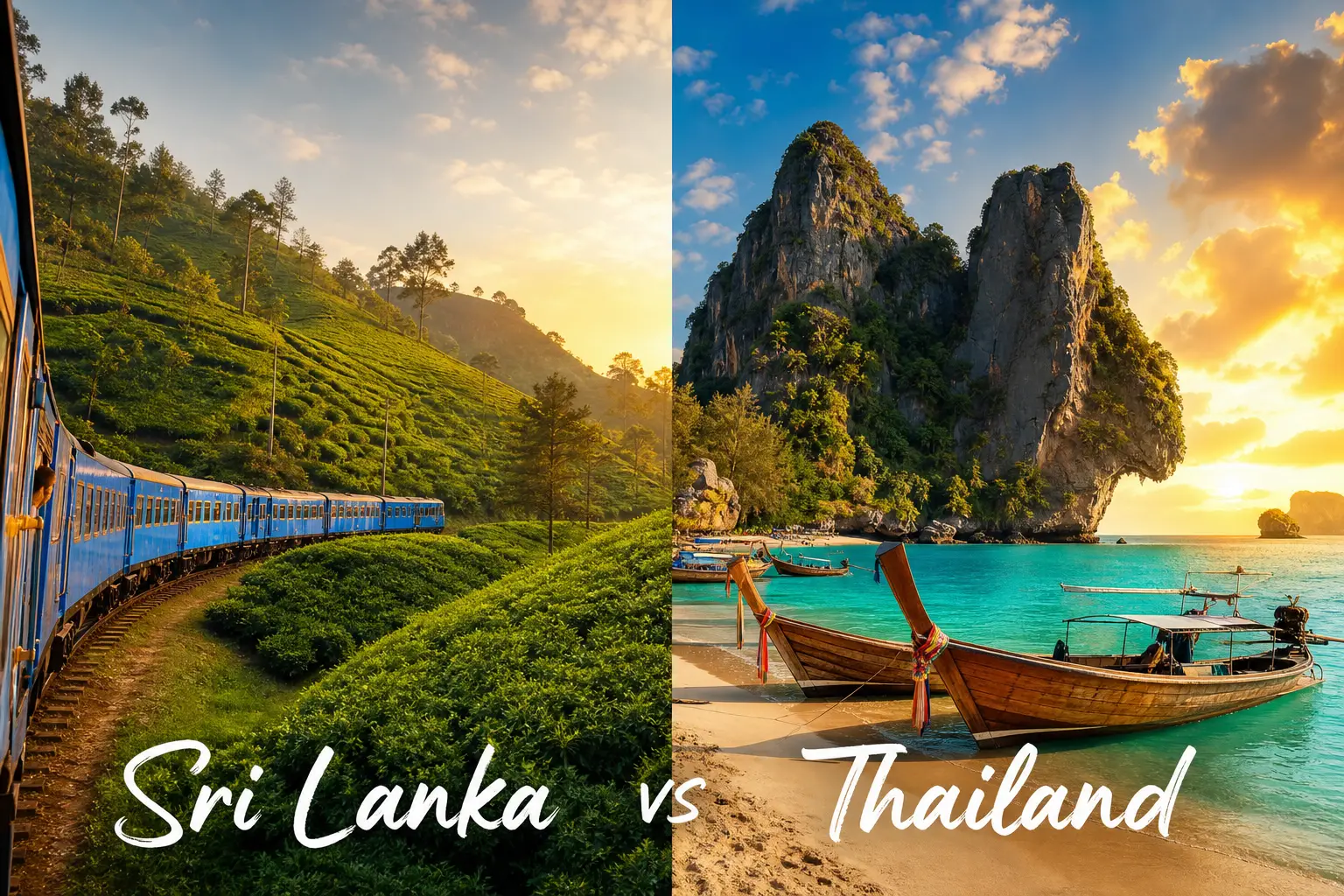
Thailand is physically much larger, so in terms of overall natural diversity it has a huge advantage: northern mountains, tropical forests, waterfalls, marine national parks, mangroves, the karst cliffs of Krabi and Phang Nga, and islands in both the Andaman Sea and the Gulf of Thailand.
But for an ordinary tourist, large wild animals are not as easy to integrate into a Thailand itinerary. Monkeys and monitor lizards are easy enough to see, but a meaningful experience with larger wildlife requires choosing a specific national park and some luck.
In Sri Lanka, safari is much easier to build into a normal route. Udawalawe is known for elephants, Yala for wildlife including leopards, and Minneriya for large seasonal gatherings of elephants. Crocodiles, buffalo, monkeys, and birds can be seen in different parts of the country, and a national park can naturally fit between the highlands and the beach.
On the other hand, Thailand offers more marine nature and a stronger underwater world. Koh Tao is one of the best-known diving centers in the region, while the Andaman Sea offers a huge number of island and reef routes.
So Sri Lanka is stronger for safaris and the chance to see large animals on a normal trip. Thailand is stronger for overall landscape diversity, islands, marine parks, and underwater activities.
Culture and History: Both Are Strong, but They Feel Different
Sri Lanka is particularly convenient for exploring history because of its compact size. Anuradhapura, Polonnaruwa, Sigiriya, Dambulla, and Kandy can be logically combined with the mountain and beach parts of the route. Monuments from several ancient kingdoms and some of the country’s most important Buddhist sites are concentrated within a relatively small area.
Thailand has more cultural centers, but they are spread much farther apart. In Bangkok, enormous temple complexes exist alongside a modern metropolis, shopping malls, and street markets. Ayutthaya and Sukhothai add the historical layer of former capitals. Chiang Mai and the north preserve their own Lanna tradition, with distinctive architecture, food, and temples.
Everyday Buddhist culture is highly visible in both countries. But Thailand offers more urban, cultural, and entertainment scenarios around it.
If you want to combine ancient history, nature, and the ocean in one compact route, Sri Lanka is easier. If you are interested in temples, historic cities, a major Asian metropolis, and different regional cultures within one country, Thailand offers more.
Food: Thailand Is Clearly Stronger Here
Sri Lankan food can easily become one of the reasons to love the country. Rice and curry, hoppers, string hoppers, kottu, dhal, sambol, roti, fish, and seafood are bold, spicy, and often very inexpensive.
The limitation is not the local cuisine, but variety. Outside Colombo and the most tourist-oriented areas, the choice of international restaurants drops quickly, and finding a good Western-style café or quality cuisine from another country may take more effort.
Thailand is almost the opposite. Thai cuisine itself is huge and regionally varied: food in Bangkok, Isan, the north, and the south can be noticeably different. On top of that, almost every major tourist center offers Japanese, Korean, Chinese, Indian, European, and Middle Eastern food, specialty coffee, bakeries, modern breakfast cafés, and delivery.
Even on the islands, the choice is usually far broader than in comparable resort areas of Sri Lanka. Bangkok is in another category entirely, ranging from cheap street food to world-class restaurants.
If the priority is cheap and distinctive local food, both countries are good. If food is an important part of everyday life and you want to constantly switch between cuisines, cafés, and restaurants, Thailand wins very clearly.
Tourism Infrastructure: Thailand Is Far Ahead
Thailand has been receiving mass international tourism for decades, and it shows in almost everything.
Between major regions there are domestic flights, railways, intercity buses, and an extensive ferry network. Bangkok has modern urban rail transport. Taxi and delivery apps are widely used in tourist cities. In Phuket, Samui, Chiang Mai, and Bangkok, it is easy to find modern housing, gyms, international schools, private clinics, large stores, and services for long-term living.
Sri Lanka’s infrastructure is much simpler. Trains and buses cover much of the country and are inexpensive, but journeys are slow. Convenient modern transport between tourist regions is less developed, so travelers often hire a car with a driver or combine trains, buses, and tuk-tuks.
The difference becomes especially obvious during a long stay. In Thailand, you can choose Bangkok, Chiang Mai, Phuket, Samui, Pattaya, Hua Hin, and many other bases with completely different lifestyles. In Sri Lanka, the most obvious options for foreigners are concentrated mainly around Colombo and the south coast.
The downside of Thailand’s infrastructure is commercialization. Phuket, Patong, some parts of Samui, and other popular areas can feel like a huge international tourism industry. Thailand is much more convenient, but Sri Lanka can sometimes give you more of a feeling that you are still traveling through the country itself rather than through a tourism ecosystem.
Everyday Life and Remote Work: Thailand Is Stronger on Almost Every Practical Measure
For a short holiday, the infrastructure gap is not always critical. For three, six, or twelve months, it becomes very noticeable.
In Thailand, it is easier to find a long-term apartment or house, fast internet, coworking spaces, gyms, good private clinics, grocery and food delivery, international products, and a large foreign community. Bangkok and Chiang Mai are especially strong for this kind of life, but Phuket, Samui, and other major centers are also well developed.
Remote work is also possible in Sri Lanka. The south coast is gradually developing its own international scene, with more cafés and work-friendly spaces. But internet quality and electricity should be checked for the specific property, and the range of services is much smaller.
The biggest difference now is visa policy.
Thailand’s DTV: A Strong Option for Remote Workers, but the Requirements Have Become Stricter
The Destination Thailand Visa is designed, among other groups, for digital nomads, remote workers, foreign professionals, and freelancers.
As of September 2026, the DTV:
- is valid for 5 years;
- allows multiple entries;
- permits up to 180 days per entry;
- allows one extension for up to another 180 days, after which a new period requires leaving and re-entering on the still-valid DTV.
For the Workcation category, applicants must prove their status as a remote worker, freelancer, or foreign professional. The core financial requirement is evidence of at least THB 500,000 or the equivalent. Visa fees are set by the Thai embassy or consulate handling the application and therefore vary by country.
Since August 31, 2026, the supporting-document rules have become stricter worldwide. Applicants must be citizens or permanent residents of the country where they submit the application and must provide a criminal record clearance certificate. Exact documentary requirements can still vary slightly between Thai missions, so the relevant embassy or the official Thai e-Visa system should always be checked before applying.
The DTV does not allow someone to work for a Thai company or provide services to Thai clients in the same way as a regular local employee. It is intended for remote income and professional activity based outside Thailand.
Taxes Under the DTV
The DTV is not a tax exemption.
Under Thailand Revenue Department rules, a person staying in Thailand for 180 days or more in a calendar year may become a Thai tax resident. Foreign income earned during a period of Thai tax residency and remitted to Thailand may be subject to Thai personal income tax. The final result also depends on the source of income, when it was earned and transferred, and any applicable double-taxation treaty.
So the idea that “a five-year DTV means you can live in Thailand without tax consequences” is incorrect. For a short winter stay, the issue may not arise at all, but if you actually live in the country for most of the year, tax residency needs to be considered separately.
Sri Lanka’s Digital Nomad Visa: Formally Suitable, but with Heavier Conditions
Sri Lanka also offers an official Digital Nomad Visa valid for one year and renewable annually.
It is intended for remote workers, freelancers, and business owners outside Sri Lanka. But the key requirement is not simply to show income: the main applicant must ensure a minimum monthly remittance of USD 2,000. Additional remittances are required for larger numbers of dependents.
The fee is USD 500 per year for the main applicant, spouse, and each dependent separately. For renewal, the official conditions also require proof of tax registration with the Inland Revenue Department.
Required documents include a medical report, police clearance, international health insurance, and a recommendation from the Ministry of Digital Economy.
So when comparing the legal status specifically for remote work, Thailand’s DTV looks significantly more practical for many people, despite the newer requirements and the need to show substantial savings.
Tourist Entry in 2026: The Rules Depend on Your Passport
For an international audience, there is no single visa rule that applies to everyone, and both countries now use several different entry schemes depending on nationality.
Thailand
From September 15, 2026, Thailand replaced the previous broad 60-day visa-exemption scheme with a new system. The main tourist visa-exemption category now allows up to 30 days and covers 60 countries and territories. This includes, among others, all EU member states, the United Kingdom, the United States, Canada, Australia, New Zealand, Japan, India, Indonesia, Singapore, the Philippines, Switzerland, Türkiye, the UAE, and South Africa.
Some nationalities fall under separate bilateral arrangements and therefore receive different periods. For example, ordinary passport holders from Argentina, Brazil, Chile, Peru, and South Korea have a 90-day visa-exempt arrangement, while several other countries and territories have separate 30-day agreements. A small number of passports instead use a 15-day exemption or Visa on Arrival.
Travelers using Thailand’s main 30-day visa-exemption scheme should also note that the current rules limit use of that scheme to two entries per calendar year. Immigration officers may ask for proof of accommodation, onward travel within the permitted stay, and sufficient funds.
All foreign travelers must also complete the Thailand Digital Arrival Card — TDAC before entering the country. It is free, must be submitted for every entry, and is completed online within the three days before arrival.
If your passport is not covered by visa exemption, or if you need a longer stay, Thailand’s e-Visa system offers other visa categories, including the standard Tourist Visa.
Sri Lanka
Sri Lanka requires an Electronic Travel Authorization — ETA before arrival for ordinary tourists, including nationals who qualify for a free ETA.
Since May 25, 2026, citizens of 40 countries can obtain a free 30-day tourist ETA. The list includes major English-speaking markets such as Australia, Canada, New Zealand, the United Kingdom, and the United States, as well as many European countries and major Asian markets including China, India, Japan, South Korea, Malaysia, Indonesia, and Thailand.
Singapore and Seychelles also receive a free 30-day ETA under reciprocal arrangements, while Maldivian nationals receive 90 days through the ETA system. Travelers from other countries generally remain subject to the standard ETA fees and rules.
Under the 40-country free-ETA scheme, the tourist permission is valid for 30 days and allows double entry within that original period. Longer stays can be extended for a fee.
For many readers from the UK, US, Canada, Australia, New Zealand, much of the EU, and several major Asian countries, the practical comparison is therefore simple: Thailand offers visa-free entry for 30 days, while Sri Lanka requires an ETA but often issues that ETA free of charge for 30 days. For other passports, the difference can be substantial, so the official eligibility lists should always be checked before booking.
Transport: Thailand Is Much Easier for Long Distances, Sri Lanka Is More Interesting as Part of the Journey
In Sri Lanka, transport is often part of the experience itself. Mountain railway routes pass through tea plantations and beautiful valleys. Buses are cheap and go almost everywhere. Tuk-tuks solve shorter journeys.
But from a practical perspective, travel is slow. A relatively short distance on the map can take several hours, and convenient direct connections between tourist destinations do not always exist.
Thailand is much more efficient. You can fly between Bangkok, Chiang Mai, Phuket, Krabi, Samui, and other major destinations. There are intercity trains and buses, extensive ferry routes, urban public transport in Bangkok, and familiar ride-hailing apps.
At the same time, scooters remain a problem in islands and resort areas, just as they are in many parts of Southeast Asia. Renting one is easy, but easy access does not make riding safe for beginners.
If the journey itself is part of the adventure, Sri Lanka is more interesting. If you value fast and predictable travel between very distant regions, Thailand is much more convenient.
Which Is Cheaper?
There is no single answer for Thailand because the differences between regions are enormous.
Chiang Mai and some non-tourist cities can be quite inexpensive. Bangkok can be budget-friendly or very expensive depending on the neighborhood and level of accommodation. Phuket, Samui, and popular islands are noticeably more expensive, especially if you rent a modern villa, eat frequently in Western restaurants, and use tourist-oriented services.
Sri Lanka is cheaper on average for basic expenses: local food, public transport, simple accommodation, and many everyday services cost less. But an active trip around the country can quickly raise the budget: safaris, entrance fees, a car with a driver, and frequent changes of accommodation all cost significantly more.
An important difference is that in Thailand it is easier to pay more for comfort. The market for modern apartments, villas, international restaurants, clinics, gyms, and services is much broader. In Sri Lanka, you can spend less, but the upper end of everyday infrastructure is also narrower.
If the goal is to live simply and cheaply for a long time, Sri Lanka usually wins. If you want a good balance between cost and highly developed infrastructure, some Thai cities — especially outside the islands — may be more practical.
Healthcare and Everyday Comfort: A Major Advantage for Thailand
For an ordinary tourist, healthcare rarely determines the destination. For a family, someone with chronic medical conditions, or a long winter stay, it becomes much more important.
Thailand has developed a large private healthcare sector that also serves international patients. Bangkok, Chiang Mai, Phuket, and other major centers have modern private hospitals and a wide range of specialists. Many foreigners deliberately travel to Thailand for serious examinations and treatment.
In Sri Lanka, good private healthcare is easiest to access in Colombo and other major cities. In a small beach town, options can be much more limited, and a serious problem may require travel to a larger medical center.
The same applies to everyday services: shopping malls, delivery, international products, sports infrastructure, and service apps. If everyday convenience matters, Thailand is clearly ahead.
Safety: The Main Shared Risk Is the Road
Both countries are generally suitable for independent travel, but it is more useful to think about specific risks than about a general “country safety” ranking.
In Sri Lanka, extra caution is needed on the roads and in the ocean. Traffic can be chaotic, while open beaches may have strong waves and rip currents. In areas with wild elephants, travelers should never approach animals just for a photograph.
In Thailand, one of the clearest risks is road accidents, especially on scooters. Tourist islands can create the false impression that a motorbike is a simple part of the holiday, while an inexperienced rider is actually entering complex left-hand traffic.
At sea, risks depend on season and coast. A red flag on a Phuket beach or heavy surf in Sri Lanka should not be ignored simply because other people continue swimming.
In both countries, proper medical insurance is important. If you rent a motorcycle, check separately whether your insurance covers riding with the driving documents you actually hold.
Which Is Better for a First Trip?
If this is your first trip to South or Southeast Asia, Thailand is usually easier. Tourism infrastructure is highly developed, English is sufficient in popular areas, travel between regions is straightforward, and the choice of accommodation and food is enormous.
But that same convenience can sometimes make Thailand feel less adventurous. You can fly to Phuket, live in an international resort area, eat familiar food, and barely interact with the rest of the country.
Sri Lanka pulls travelers into the local environment more quickly. Trains, small towns, mountains, safaris, and different coastlines naturally become part of the route.
If you have 10–14 days and want the most eventful trip possible without domestic flights, I would more often choose Sri Lanka.
If you want to choose your own style of holiday — metropolis, mountains, islands, nightlife, diving, wellness, restaurants, or simply a good beach — and get the most developed tourism infrastructure, Thailand is stronger.
Where Is Better for Several Months?
For long-term living, the advantage usually shifts toward Thailand.
You can choose Chiang Mai for a calmer and relatively inexpensive urban lifestyle, Bangkok for maximum opportunities, Phuket or Samui for the sea and international infrastructure, or Hua Hin for a quieter resort format. At the same time, the DTV provides a clear official mechanism for long-term stays by remote workers.
Sri Lanka is more attractive if you want a simpler life by the ocean, lower costs, and less of a feeling that an enormous industry has been built around foreigners. The south coast can be a very pleasant base for several months, especially if surfing, beaches, and nature matter more than malls, clinics, and services.
But under current rules, Sri Lanka’s formal Digital Nomad Visa is noticeably less attractive than Thailand’s DTV.
So for stable remote living with developed infrastructure, I would more often choose Thailand. For a simpler, cheaper, ocean-focused lifestyle, provided the visa situation is handled appropriately, Sri Lanka may feel better.
So, Sri Lanka or Thailand?
These countries do not compete in exactly the same way.
Sri Lanka is the better choice for a compact, big journey. In one trip, it is easy to combine history, mountains, tea plantations, safaris, trains, and the ocean. Everyday life is cheaper, wildlife is easier to access, and the country gives you a constant change of scenery without needing to fly across half the country.
Thailand is the better choice for breadth of options and infrastructure. There are more beach destinations, islands, diving opportunities, restaurants, cities, entertainment, quality healthcare, housing options, and bases for remote work. At the same time, the country is so large and diverse that one trip cannot realistically cover it.
If you want a simplified decision:
- First eventful two-week trip — probably Sri Lanka.
- Beach holiday with the widest choice of islands and calm seas — Thailand.
- Food, nightlife, diving, healthcare, and urban infrastructure — Thailand.
- Safaris, tea-covered mountains, scenic trains, and a compact journey — Sri Lanka.
- Several months of remote work with a sufficient budget — usually Thailand, especially because of the DTV.
If you have the opportunity to visit both, they are different enough that they do not replace one another. After Thailand, Sri Lanka will not feel like a “simplified version” of it, and after Sri Lanka, Thailand will not feel like just another tropical destination.
Information on visas, the DTV, TDAC, Sri Lanka’s Digital Nomad Visa, and tax rules was checked on September 15, 2026. Immigration and tax requirements can change, so they should be verified again on official websites before travel or any long-term move.
Sources
- Sri Lanka Tourism — weather and beach seasons
- Sri Lanka Tourism — nature and regions
- Sri Lanka ETA — official portal
- Sri Lanka Department of Immigration and Emigration — free ETA for 40 countries
- Sri Lanka Department of Immigration and Emigration — Digital Nomad Visa
- Tourism Authority of Thailand — climate and weather
- Tourism Authority of Thailand — Southern Thailand
- Tourism Authority of Thailand — Ko Lanta
- Tourism Authority of Thailand — Ko Samui
- Tourism Authority of Thailand — Ko Tao
- Thailand Ministry of Foreign Affairs — 2026 revision of visa exemption and Visa on Arrival schemes
- Royal Thai Embassy, London — current visa exemption and Visa on Arrival rules
- Thailand e-Visa
- Thailand Immigration Bureau — Thailand Digital Arrival Card
- Royal Thai Embassy, Vientiane — worldwide DTV requirements effective August 31, 2026
- Thailand Revenue Department — Personal Income Tax
- Thailand Revenue Department — foreign-sourced income guidance