Today, as a manager of several guesthouses and villas in Sri Lanka, I can say that Airbnb remains a useful channel for people renting out accommodation, from one private room to a small property. It works well for individual and unusual spaces because a host can show their character in detail. Airbnb is not a guarantee of occupancy, profit or legal simplicity: the result depends on location, season, price, service quality, reviews and the rules that apply where the property is located.
In my own figures for specific properties, the average annual distribution of booking sources looked roughly like this: 55% from direct channels such as a website, Instagram and social groups, 35% from Airbnb and 10% from Booking. For properties without their own channels, the ratio could be around 70% Airbnb to 30% Booking. This is personal experience, not a market average or an income forecast. I tried other services too, but closed accounts that produced no requests for a long period in order not to spend time or pay for an unnecessary channel manager.
Getting started with Airbnb
First check that you are allowed to rent the property. In Sri Lanka, the relevant questions may include local rules, the lease, the owner’s consent, municipal requirements, tourist-accommodation registration and tax obligations. Sri Lanka Tourism describes categories such as homestays, rented homes, rented apartments, guest houses and villas. Do not publish before checking which category fits your property and which documents are required.
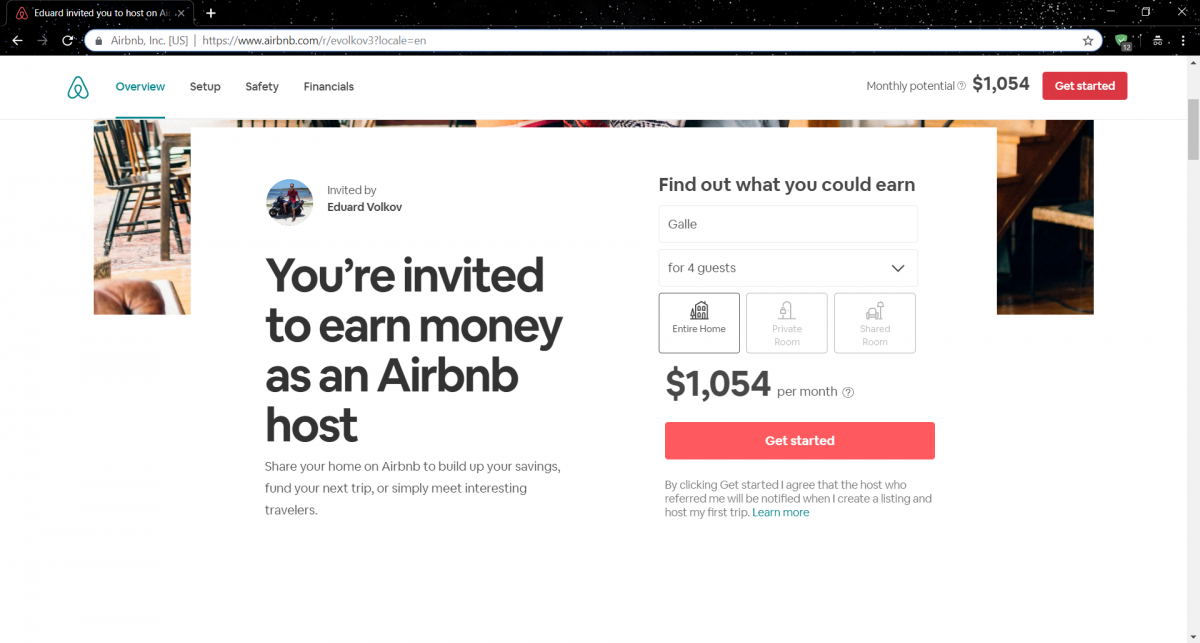
You can register through Airbnb’s step-by-step interface. This article includes the author’s invitation link; it is a referral link, and Airbnb itself displays the current terms and any possible benefit. It does not guarantee registration, bookings or income. Complete the listing carefully: add honest photographs, accurate room and amenity details, house rules, check-in and check-out arrangements, minimum stay and the preparation time needed between guests.
Photos should show the size, light, view, bathroom, kitchen, stairs, parking and limitations. Do not hide construction, road noise or the absence of hot water behind a beautiful first image. Check the calendar before publishing and appoint somebody to answer guests, meet them and organise cleaning if you do not live nearby.
How guests pay and when you receive the money
Airbnb generally collects the guest’s payment before check-in and usually initiates a host payout about 24 hours after the scheduled arrival. That does not mean every country and reservation pays into a bank account exactly the next day. Timing depends on the reservation type, payout method, account verification, length of stay, refunds and the bank or financial service.
Add and verify an available payout method before your first booking. Airbnb shows options according to location and account; possible methods include bank transfer, PayPal, Payoneer or Western Union, but availability, fees, limits and speed vary. Do not promise yourself an instant, fee-free withdrawal until you have read the terms for your account. Check the recipient name, currency, bank details and conversion charges. Keep a buffer for the first payout and separate operating money reserved for cleaning and repairs.
Calculate profit, not turnover
Booking income is not simply the nightly price multiplied by the number of nights. Your calculation may include the nightly rate, cleaning and other permitted charges, then subtract the Airbnb service fee, co-host payments, bank charges, currency conversion, taxes, cleaner wages, utilities, repairs, internet, supplies and empty days between stays. Monthly stays may be paid in instalments, so do not treat the whole booking value as money available on one day.
Use a simple table with date, property, nights, nightly rate, discount, cleaning, platform fee, payout, bank fee, preparation cost and final profit. Track occupancy and average price separately: high occupancy at a low rate may be worse than fewer bookings at a rate that covers the operation. Keep payment and expense records. For tax questions, speak to a local accountant or tax adviser because the answer depends on residence and business structure.
Smart pricing and manual control
Airbnb pricing suggestions can be a starting point, but they do not replace local research. Compare similar properties by season, distance to the beach or town, air conditioning, breakfast, parking, view, cancellation terms and reviews. Set a minimum below which the property loses money and a maximum for periods of stronger demand. A platform suggestion may not include your renovation, staff, taxes or the needs of a particular room.
Change prices based on clear signals: days until check-in, weekdays, holidays, season, local events and the actual conversion from views to bookings. After a change, check the calendar and currency. Never describe an automated suggestion as a guarantee that your listing will rank higher or earn more.
Service fees
The guest sees a total that includes Airbnb’s service fee, while the host receives a payout after deductions. Airbnb uses different fee structures. Under the split-fee structure, the guest pays part and most hosts pay around 3%, with exceptions. Under the single-fee structure, the main fee is deducted from the host payout and is commonly around 14–16% for many listings. Traditional hospitality listings and listings using management software may follow another structure. Check the current breakdown for the reservation and the Airbnb Help Center, not an old article.
When comparing Airbnb with Booking or direct sales, include more than the platform percentage. Consider customer acquisition, support, refunds, response time, calendar synchronisation, double-booking risk and manual work. A higher fee may sometimes pay for convenience; at other times a direct channel may be better. Your own records should decide.
Instant Book and the calendar
Instant Book lets a guest reserve without a separate host approval, but it requires discipline. Before enabling it, complete house rules, guest requirements, check-in window and calendar. Airbnb lets hosts set advance notice, preparation time between bookings and minimum or maximum trip length. An inaccurate calendar can create a conflict and consequences for cancelling.
Do not enable Instant Book only because somebody promises better ranking. Decide whether you can handle a late arrival, urgent cleaning and quick replies. If several people manage the property, create one process for checking availability, sharing changes and stopping sales during an emergency.
Cancellation rules and reviews
A cancellation policy affects both appeal and financial risk. Strict terms may deter some guests, while flexible terms leave the host exposed to an empty period before peak demand. Choose a policy that matches your ability to replace a booking and read Airbnb’s current terms. Host cancellations can lead to fees, blocked dates and other consequences. Do not promise a refund or keep a reservation outside the platform’s rules without understanding the result.
Ask for reviews honestly, but do not offer money or a service in exchange for a positive rating. Leave a factual review after checkout, document problems through official tools and reply to public feedback calmly. Reviews show what to improve: cleanliness, arrival instructions, quiet, internet or the accuracy of photos. Do not manipulate ratings or hide important defects.
Property location and guest instructions
Place the listing on the map as accurately as Airbnb’s settings and safety requirements allow. “Near the beach” is not enough if a guest does not know the walking distance, slope, entrance or whether a car can reach the door. The address and the way it is disclosed must follow the platform’s rules and local requirements. Do not publish unnecessary information about neighbours, staff or restricted rooms.
Prepare arrival instructions before the first booking: route from a visible landmark, emergency contact, Wi-Fi, water and electricity guidance, quiet hours, rubbish, air conditioning, keys and what to do during a power cut. Read it as somebody who has never visited the area and may not use local maps confidently.
What to organise before the first booking
- cleaning, linen, towels, soap, toilet paper and replenishment of supplies;
- locks, electricity, water, air conditioning, hot shower, Wi-Fi and basic fire safety;
- a clear check-in process and a backup way to access the property;
- contacts for a cleaner, technician, driver and backup person;
- insurance, if available and genuinely covering short-term rentals;
- licences, registration and tax treatment checked before publication.
If you manage several properties, you can use a channel manager, but first check compatibility, cost and access permissions. Automation does not repair an incorrect calendar or remove the need to review listings. Multiple platforms diversify demand but increase double-booking risk unless calendars are synchronised.
Host checklist
Before publishing, check your right to rent, documents and local requirements. Calculate the minimum profitable rate, photograph the property honestly, complete amenities and rules, set the calendar, add a payout method and prepare cleaning. After every stay, compare real expenses with your table, refresh photos and check whether fees, payout methods or platform rules have changed.
Airbnb can be a useful booking channel, but successful hosting is not a publish button. It is a repeatable operating system: an honest listing, an informed price, quick replies, clean accommodation, clear arrival, lawful operation and control of the money. That is how you learn whether the platform is genuinely useful for your property rather than merely attractive in an old promotional description.
Sources: Airbnb: getting started as a host; Airbnb: payout methods; Airbnb: service fees; Airbnb: booking settings; Airbnb: host cancellations; SLTDA: tourist accommodation registration; SLTDA: Home Stay programme; Sri Lanka Inland Revenue Department: income tax.